


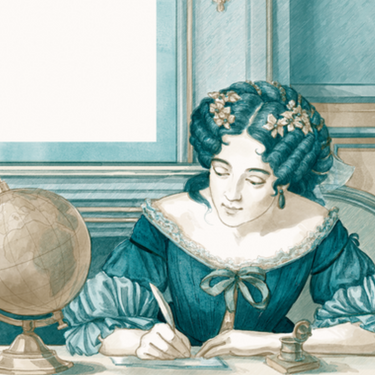

Wit, wine and good company: the spirit of Hortense Mancini
Last month, guests gathered at our cellar door for an evening our namesake would have approved of: good wine, good company, and a story worth telling. Our in-house history aficionado Jackie Oakley led us through the life of Hortense Mancini, Duchess Mazarin – one of the most remarkable women of the 17th century, and the closest friend of Charles de Saint-Évremond.
Saint-Évremond – soldier, wit, and early champion of Champagne – had arrived in London as an exile, welcomed by Charles II to a Restoration court newly in love with theatre, music, fine food, and wine after the puritan years of Cromwell's Commonwealth. More than three centuries later, a Champagne family planting vines on the chalk of Kent gave our estate his name. But this evening belonged to the woman who became his dearest friend.
The richest heiress in Europe
Hortense Mancini was born in Rome in 1646, one of the famous “Mazarinettes” – the nieces Cardinal Mazarin brought to Paris and groomed for the grandest marriages in Europe. The exiled Charles II himself sought her hand; the Cardinal refused. Instead, at 15, she was married to Armand-Charles de la Porte, who took the title Duke Mazarin and, with her, the Cardinal's vast fortune. It made her one of the richest women in Europe, and one of the least free.
Her husband's jealousy and growing religious zeal turned the marriage into confinement. In 1668 she fled Paris at night, disguised as a man, and spent the next seven years crossing Europe – Rome, then Savoy – pursued by her husband's agents. She also did something almost unheard of: she published her own memoirs, in French and English, to tell her side of the story. In December 1675 she rode into London, where the King welcomed her to court.
London's most brilliant salon
It was in London that Hortense and Saint-Évremond found one another: two exiles, both quick-witted, both happiest in good company. Together they made her rooms at St James's, and later in Chelsea, the setting for London's most celebrated salon, which ran for almost a quarter of a century.
It borrowed from the great salons of Paris, but had a spirit of its own. Rank mattered less than what you brought to the table. Ambassadors, ministers, writers, and musicians debated philosophy, science, and literature, played cards, and heard the latest plays and music – the playwright Aphra Behn, who wrote in Hortense's honour, may well have been among them. One contemporary letter describes Hortense and a friend practising their fencing in St James's Park, swords drawn beneath their nightgowns, to the astonishment of passers-by.
And through it all ran wine – Champagne above all, which Saint-Évremond believed did more than any other wine to lift conversation and sharpen wit. He was the salon's intellectual partner for more than two decades, dedicating essays and verse to Hortense in a devoted, lifelong friendship.
A life on her own terms
Hortense never went back. When her husband turned to the English courts to force her return, she stood her ground and stayed. The revolution of 1688 cost her much of her royal pension, and money grew tighter, but she kept her doors open in Chelsea and the conversation going until her death in July 1699, aged 53. Saint-Évremond remained at her side to the end.
She left behind a remarkable thing for a woman of her time: a life told in her own words, and lived largely on her own terms.
A glass to Hortense
Saint-Évremond outlived her by four years, still writing for his friends and, we like to think, still pouring Champagne. His own story is one for another evening. For now, it is enough to know that the kind of conversation Hortense presided over – curious, generous, and best enjoyed with a glass of something sparkling – is still very much alive, just a little further from London, on the chalk of Kent.
Opening hours
Wednesday - Sunday
- April - September
- 11:00 - 18:30
- October - March
- 11:00 - 17:30
Social



- © 2026. All rights reserved. Domaine Evremond.
- Privacy policy
- Cookie policy
- Anti-slavery statement
